Friday, February 8, 2019

The Ticuna people and Reinaldo

A fellow traveler described his visit to the Ticuna people as among the top three meaningful experiences of his life.  After meeting our native Ticuna guide, Reinaldo, and learning his story, I believe it.

It's hard to put your finger on what might cause this feeling.  The lack of modernity coupled with the people's satisfaction with their lifestyle is clearly a contender.  Perhaps knowing that only 40 years ago these people survived by hunting (with blowguns) wild game between their widely separated forests homes.  (Reinaldo, now 40-ish, grew up in this world.)  The absolute but unstated confidence that they could walk into the jungle and do just fine, thank you very much, is certainly a factor.  (Reinaldo did just that until a few years ago.)  They know that they can handle whatever the jungle sends their way and be happy.  (Reinaldo has stared down a large jaguar. Sure, why not?)

Aren't there reality TV shows that describe how tough it is to survive out there?  The Ticuna would laugh.  Get on with it.  (Insert eye roll here.)  No excuses to be found.

All of this, plus the scale of the Amazon and the jungle, can make you feel inadequate, overwhelmed, awed.
It's not the 'natives' that are primitive.  It's us. I know nothing.

Here we come, the Big Adventurers, roughing it in thatched roof huts with mosquito netting and plumbing. Geeze...

Maybe we should figure out what's really important and spend our lives on those matters.

In what hindsight reveals to have been a well-intentioned but misguided decision, the Ticuna peoples near the Amacayacu River were recruited by missionaries and the government to leave their scattered jungle homes and live together in a village, San Martin.  In the early 1970s, the village formed, families started building houses and trying to work out what to do next.

Today 600 people live in San Martin.  100 children ages 0-5, 100 children ages 6-11, and thereafter the children must leave the village for a boarding school three hours away by boat.  So there are no children between 12 and, say, 17, in town, unless they dropped out of school.  (By the way, nationally, rural children average 5.5 years of schooling.)  [Hey, if I had to enter boarding school at sixth grade, I'd probably stay in the village too.]

The villagers don't use furniture in their houses, (Maybe a table in every other house? or if the house is adapted to support outsider guests.)  They don't seem to need them.

The boards used to build their houses are hand sawn.

Houses are elevated to provide a practical space for their animals to live, and to give a little space between the critters of the night and the home.  Pictures of animals representing their family heritage are found on some houses.

I think that hammocks are used for beds.

The town's sidewalk is a center of life for the children and serves as a great playground.  (This photo does not show the sidewalk.)

A courtyard sits at the top of the hill and is the center of passionate soccer games.
The water level of the town's river changes about 10 feet with the rains.
Women are at river's edge throughout the day, beating clothes to wash them.


Children help and play.

Or just hang out with mom.

Pot scrubbing too.

I met one woman who had completed high school.  She proudly displayed her diploma in her home's main room.
Similarly, ornamental woodwork can show pride in a family's house.

The villagers have greatly reduced their hunting, expecting that the animal population and proximity will increase, and thereby make their locale an attractive ecotourism destination.
So the men and boys have increasingly turned to fishing.
They paddle to shores daily, looking fore the best fishing holes.
 These boys are using their nets and patience.

This blog digressed from the awe felt by my fellow traveler, which I share.  Perhaps after reflection, we'll be able to better describe the source of our reaction.
Until then...

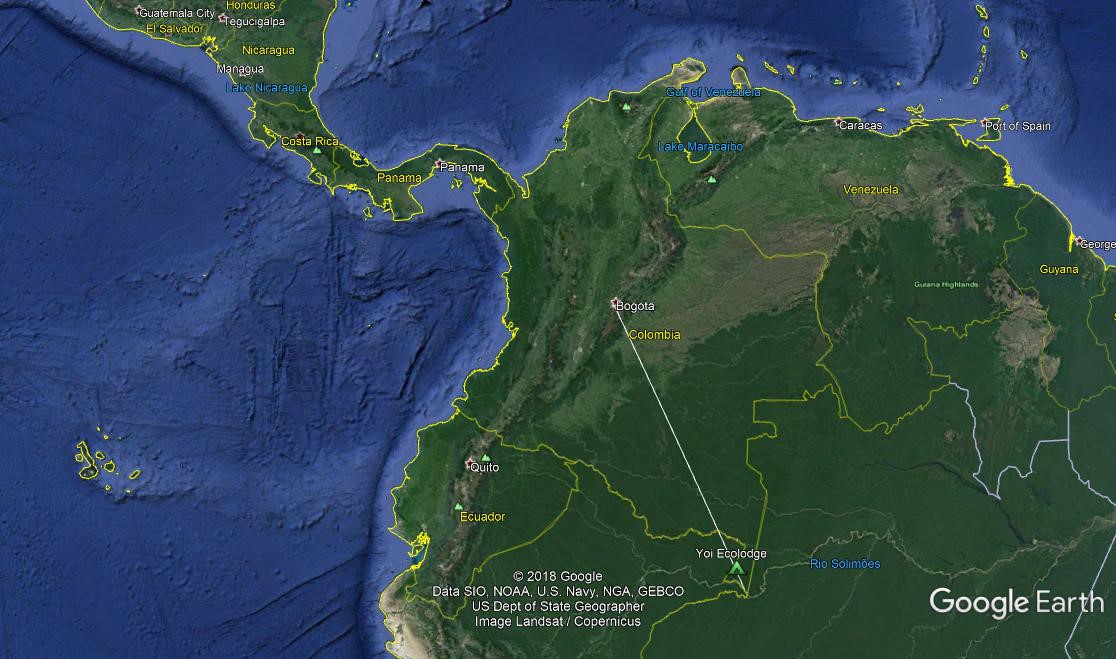
Colombian Amazon: Getting Around.

Friends, the number one reader for this blog is my Mom, Eleanore Meinhardt.
She's always asking me just how we get around from place to place.  :-)
So, Mom, here's a "typical" trip.

My buddy, Ted Gutierrez, visited from New York to see the Colombian Amazon.  The two of us rendezvoused at the Bogota airport, and slept at the nearby Marriott so we could catch an early morning flight to Leticia, a Colombian border town as far from Bogota as you could get (and still be in Colombia).
 (Remember, Gentle reader, that Colombia is bigger than France and Germany combined.)


We were greeted by our liaison, Adriana, who accompanied us by taxi to the Amazon riverbank.  Here Adriana pockets the cash balance we owed for the guides' services.


The riverbank was crammed with floating docks to adapt to the changing water levels of the Amazon.  Leticia is a frontier town, the crossing point into Brazil, and with Peru directly across the river.  Think of El Paso, Texas in the 1850's.  But for all the craziness, there was time for Ted and me to enjoy a snack before going up river.  (Colombianos thrive on fresh-squeezed juices and pastries.  There's no such thing as bottled juice or day-old bread.)


Down to the river bank to look for our dock.
 Not here...


Or here...

But eventually Adriana shows us to the right spot.  We join the crowd.


Adriana has done her job and we're confirmed on the passenger manifest.  They're expecting us on board this luxury liner.


It's much more refined than the motorized canoe that Lauren, Luke and I took on the Ecuadoran rivers.  Four seats across!


We don life preservers and settle in.  The luggage and supplies are tied to the roof.


We're underway and the driver keeps a constant vigil for debris floating on the Amazon, dodging logs.  I calculate the volume of trees I see going by, and it's impressive.  It's easy to see how the Amazon delta got so big.


The Colombian Navy sits astride the triple border of Brazil and Peru.  We watch the river go by for two hours at 30 knots, making our way upriver to reach the mouth of the Amacayacu River.  There's a large tree that serves as our rendezvous point.

A few people of the river pass by, but generally this part of the world is sparsely populated.

Our native guide is there. Hurray! Reinaldo is accompanied by a translator, Lola, from
Germany.  Lola is volunteering her services as part of the WorkAway volunteer program. (See www.workaway.info if you're interested.)


Ted and I join Reinaldo and Lola in a small boat for the trip up the Amacayacu.

After 30 minutes, we pass a small indigenous village of the Ticuna people, San Martin.  Women wash clothes and the children play in the water.
600 people live in this village, which was founded in the early 1970s after a campaign by missionaries and the government to gather indigenous peoples into a central location.  In hindsight, a proposal of dubious merit.


Here's a time lapse video of the river.
We arrive at the Yoi Ecolodge in the late afternoon, and prepare for our night hike.

Ok, Mom, how was that?
Love,
Mel

Once I Pass'd Through a Populous City


Once I Pass'd Through a Populous City

  Once I pass'd through a populous city imprinting my brain for future
      use with its shows, architecture, customs, traditions,
  Yet now of all that city I remember only a woman I casually met
      there who detain'd me for love of me,

From: Leaves of Grass by Walt Whitman

Whitman's thoughts are with us every day.  Though we've seen many wonderful creatures and places, it's been the people of Colombia that have made the biggest effect on our lives and memories. 

Overall, we've been overwhelmed by the gracious welcoming we've received from all Colombians.  Sure, we're the gringo curiosities...rare indeed in this part of the world, but without exception (and in spite of my still-terrible Spanish) every person we've met has been helpful and accommodating.  I doubt that would have been the case had the situation been reversed in the US.  (I hope that I'd be wrong, and my that my expectations could be higher.)  Everyone here tries to help...even if they have no idea what I need, they still try.  Good on them and thanks!

Let me rethink that.  There's one anonymous group of people that do me no favors.  The drivers of private buses.  Those men are crazed.  I'm sure that I'll write more of them later, but not right now.  Today I'm still quite upset.  Earlier this week the friend of a friend was struck by a bus and killed crossing a street.  Luke and I saw her body lying in the road soon after the accident.   Two hours later, she was still there, uncovered. 

I need to take a break from this topic.

Friday, February 1, 2019

Amazon Small World, Colombia

Night Hike Number Two, near the borders of Colombia, Peru and Brazil, revealed ever more critters. (Find more little critters at this earlier blog post.)
But let's be honest, we all want to see the spiders.

The tarantulas come first.


Maybe because this night hike was in the late January rainy season, and the ground was often soaked (better for the spiders?).  Or maybe we got lucky.


I'm told tarantulas are harmless to humans.  Here a Colombian friend demonstrates.


But I'm not so sure.  Here's what I remember from biology class...

Not all spiders were as cute and cuddly.  Here's an Amazon whip spider (Amblypygi); a clawed spiders without scorpion tail or poison.  Perfectly harmless.  This is Ted's hand holding one.  Ted came down with significant nausea soon thereafter.  Coincidence? Sure...


Not every spider's a man-eater...


This spider might be waiting for the larvae inside the protective froth to emerge in time for dinner.


This guy didn't wait, and he showed up for our dinner.


Or maybe to stalk this super-tiny mantis perched on a dinner glass.


It doesn't take long to realize a major difference between the Amazon and Galapagos.

  • In the Galapagos, most or birds land animals don't prey on each other.
  • In the Amazon everything is under attack, and is attacking everything else.
A butterfly looks tasty.

Perhaps dinner for this poisonous frog.

A chameleon waits his turn in line.

After dinner, it's time to lay your eggs.
This fist-sized female will use the cleaver at her thorax's end to slice into a plant and lay her eggs.


 She's closely related to this North American species...

 Cousins clustered on a nearby street corner looking for some action.


Of course, there's always someone at the apex of the food chain...
Our hero, Little Peep, now goes by "Poco Peep".